My recent essay on the SaaS market argued that AI pressure is unlikely to apply evenly. The exposed segment was products in the middle of the market that are expensive enough to prompt examination, bounded enough to cleanly emulate, and shallow enough in terms of integrations that rebuilding them would not be outrageous. They were neither the cheapest tools nor the deeply embedded enterprise platforms protected by years of integration, workflow dependence, and switching costs.
I think there is a geospatial analog to that soft middle that may have a similar look. It’s not the part of the market where geospatial is fused directly into operations, such as utility networks tied to asset management, transportation systems tied to dispatch and monitoring, emergency management environments, defense workflows, and the more serious forms of digital twins that tend to be baked into the infrastructure. These use cases often live in some of the earliest and most deeply established verticals for geospatial and are embedded and costly to replace.
The softer middle is the layer above that, such as location-intelligence products, site-selection tools, spatial dashboards, workflow wrappers around common analysis tasks, and other bounded products that deliver real value but often sit adjacent to enterprise systems rather than inside them. That makes them more exposed to the same forces now pressing other parts of the software industry. If a buyer can reproduce enough of the outcome with open components, cloud infrastructure, and AI-assisted development, the old build-versus-buy logic weakens. If a buyer can get spatial capability embedded in some other platform, the buyer may never enter the geospatial market on traditional terms at all.
The geospatial industry has long had a habit of describing itself in terms that set it apart from mainstream technology. Sometimes that reflected real technical differences, legitimate complexity in data, tooling, and methods. But it also encouraged a recurring habit of naming new waves of change from inside the category rather than asking whether the category itself was becoming more permeable. GIS became enterprise GIS, then web GIS, then cloud GIS, now GeoAI. Each turn preserves geospatial as the primary identity at exactly the moment the broader market may be getting better at absorbing spatial capability into general platforms.
Today, a non-traditional buyer is unlikely to think, “I need GeoAI.” That buyer is more likely to think, “I need better site selection,” or “I need to understand what changed around these assets,” or “I need routing, monitoring, forecasting, or territory management.” The spatial reasoning is still there. It may even be central, but the buyer won’t necessarily see the requirement as an entry into a geospatial category.
That can affect adoption of geospatial is new verticals. Previous generations of geospatial tooling often required a buyer to cross a cultural and technical threshold. The buyer had to decide to “do GIS,” adopt geospatial software, or bring in specialized practitioners. AI changes that by lowering the barrier to experimenting with bounded spatial workflows inside more familiar environments. A non-traditional user can now test proximity analysis, site ranking, change summaries, or routing logic inside a cloud data stack, a BI environment, a logistics product, or an AI-assisted internal tool without first committing to geospatial writ large. That doesn’t necessarily reduce the need for spatial thinking and, in fact, may increase it. But it can divert demand away from the traditional geospatial market by changing the path through which that demand is met.
The wide availability of open-source software and open data reinforces that shift. Open-source spatial libraries are functionally equivalent or superior to proprietary counterparts, as evidenced by the adoption of components such as GDAL inside proprietary platforms. Cloud infrastructure and AI-assisted development make it easier to stand up spatial workflows without a heroic amount of engineering. World models and geospatial foundation models push further still, not because they make geospatial easy, but because they make more of the stack composable and more accessible to adjacent platforms and non-traditional users.
There is some tension between AI and the open-source and open-data communities, but the practical fact that is hard to miss is that AI tools tend to default toward the open stack. Increasingly, I see them reaching early for models such as Clay and Prithvi, along with the open tools and data sources that sit around them. Over time, this may reduce the likelihood that a new user encounters spatial capability first through a traditional geospatial buying process.
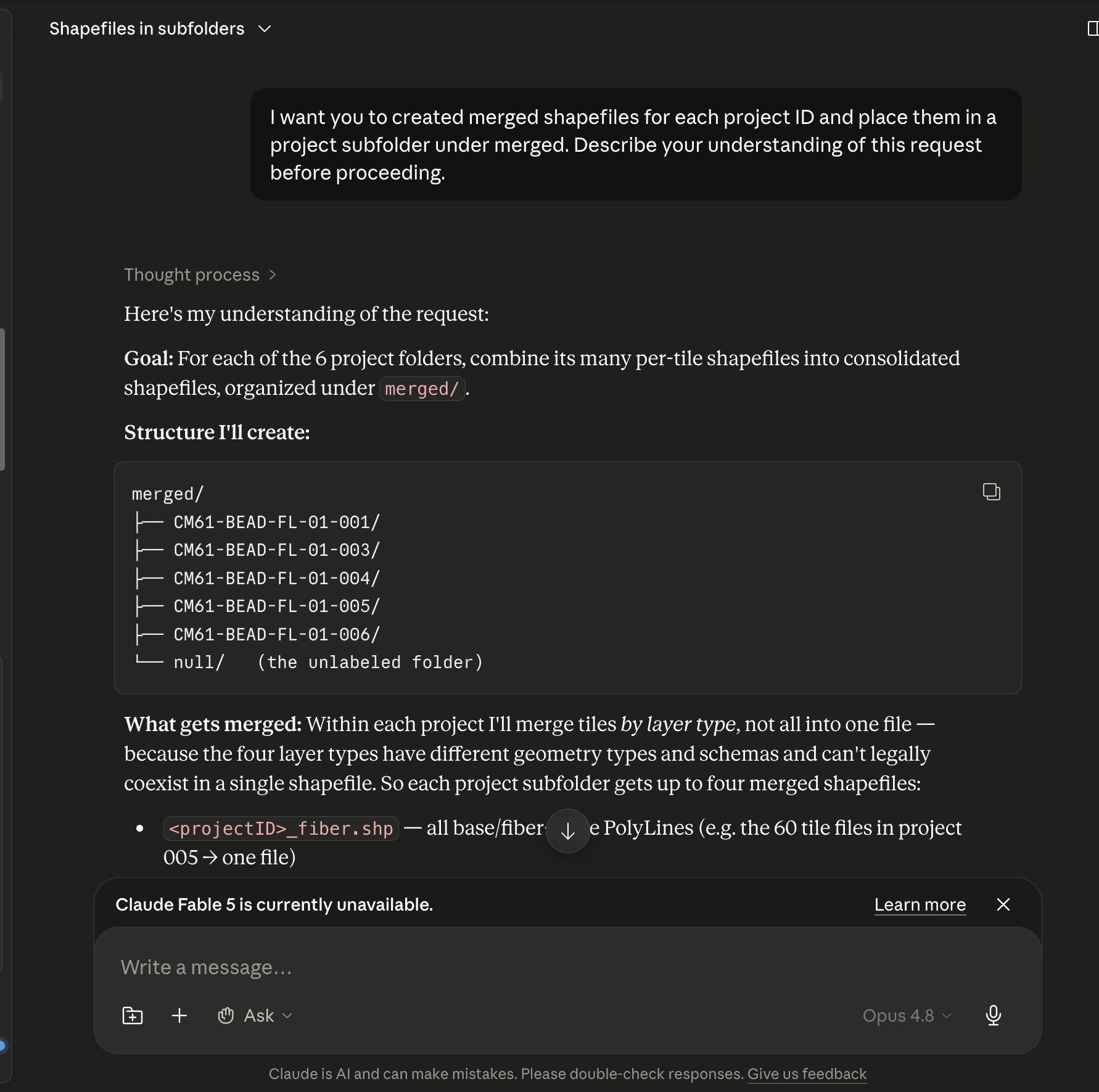
I have watched Claude Cowork reason through natural-language prompts, select tools, identify algorithms, build containers, test, run, and deliver. I have never seen it begin by asking which sales rep to contact or which license tier to buy before attempting the work. It assumes the task is solvable from the available stack and proceeds accordingly.
None of this means new users will vibe code their way around real geospatial requirements. The enterprise, governance, and security constraints identified in the SaaS essay still apply, but a technically adept person in the IT department of a small transportation logistics company can now build a credible prototype and learn a great deal about geospatial along the way. What they learn in that process will shape how they approach the market when they eventually look for enterprise-grade solutions. By then, they may be shopping for specific capabilities, integrations, and guarantees rather than entering the market on the geospatial industry’s own terms.
So I do think there is a geospatial analog to the SaaS story. A soft middle likely exists here as well in the form of products focused enough to reproduce, useful enough to command real spend, and insufficiently embedded to enjoy the protection that comes from true operational infrastructure.
But the greater risk may be diversion. AI doesn’t need to eliminate demand for spatial reasoning in order to pressure the geospatial market. It only needs to make it easier for new users to satisfy that demand somewhere else. If non-traditional buyers can reach spatial capability through general AI platforms which default to open components, then a meaningful share of future demand may never arrive through the front door marked geospatial at all.
That seems to me like the more interesting question for the next few years. Not whether geospatial has a soft middle, though it probably does, but whether the industry can keep control of new market entry at the very moment spatial capability is becoming easier to absorb into everything around it.
These are exciting times in geospatial, especially open geospatial. For all of the real concerns about how AI is affecting open source and open data communities, it is also changing how users discover, learn, interact with, and acquire geospatial tools and capabilities. Communities that have always needed to be flexible to adapt to the needs of their participants may be far better suited than rigid sales or procurement channels to adjust to the new landscape.
