In February 2026, Gary Gale published a brief post describing a problem that, on its face, looked mundane. A volunteer‑maintained mapping project called Vaguely Rude Places had experienced an abrupt surge in traffic. Daily requests jumped from the low thousands to the hundreds of thousands. There was no corresponding spike in public interest, no viral event, and no new feature release. The traffic was almost entirely automated and originated from AI crawlers rather than people viewing maps (Gale, 2026).

The practical consequence was noticeable immediately. A monthly tile allocation, sized reasonably for human use, was exhausted in a single day. The map went offline for the remainder of the billing period. This happened not because of a technical failure, but because a cost threshold had been crossed far faster than the system was designed to accommodate. For users, the result was simple. The map was gone.
On its own, this is a small incident. No critical infrastructure failed. No global service collapsed. It is, however, a revealing stress case. It shows how open geospatial infrastructure behaves when exposed to a new class of demand. That demand is continuous, automated, and indifferent to the social and economic assumptions that shaped the system in the first place. This is not an isolated story. It is an early signal of a broader shift already underway.
Not an Isolated Case
What happened to Vaguely Rude Places is not unique. Similar signals are appearing across the open geospatial web, particularly in projects that sit low in the dependency chain and quietly support a wide range of downstream applications.
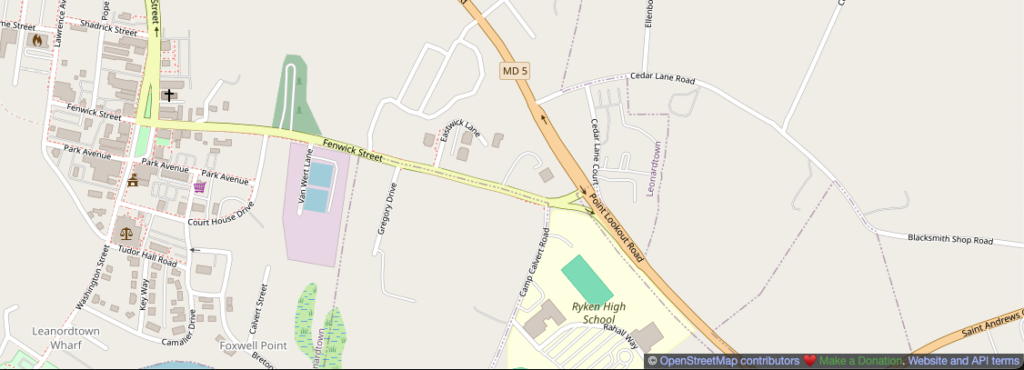
OpenStreetMap, which underpins countless maps, services, and products, is now described by its own maintainers as being in constant conflict with large‑scale scraping activity. According to accounts from within the project, a significant portion of this traffic no longer resembles traditional search indexing or casual reuse. Instead, it arrives continuously and at scale, often routed through residential IP proxies that make conventional mitigation strategies difficult to apply consistently (Slater, as cited in Bakare & Saner, 2026).
The operational implications are no longer theoretical. OSM operators have publicly warned that sustained crawler activity could jeopardize the project’s ability to operate within its existing cost structure. Infrastructure expenses rise quickly when access patterns shift from human use to automated extraction, particularly for services that were never designed or funded to support persistent machine‑scale demand (Heise Online, 2026).
These pressures are not confined to geospatial infrastructure. Maintainers of open‑source projects in other domains report that the overwhelming majority of inbound traffic now originates from automated agents rather than people. In some cases, the resulting load has been severe enough to force temporary shutdowns or the introduction of aggressive access controls that would previously have been unthinkable for openly accessible projects (Slashdot, 2025).
Taken together, these signals point to a broader pattern. Open geospatial infrastructure is especially exposed because it represents high‑value training data and is largely maintained by volunteers and nonprofit organizations. The combination makes it both attractive to large‑scale automated consumption and structurally ill‑equipped to absorb the costs that follow.
Quantifying the Impact
The signals described above are not just anecdotal. They are reinforced by measurements from infrastructure providers that sit close to the traffic itself. Recent analyses indicate that AI crawlers now account for the majority of automated web traffic. In terms of raw request volume, their activity far exceeds that of traditional search indexing and other long-standing forms of machine access (Fastly, 2025; Cloudflare, 2025). This is not a diffuse phenomenon, as a relatively small number of organizations are responsible for a disproportionate share of the load, concentrating impact rather than spreading it evenly across the ecosystem (Fastly, 2025).
The nature of this traffic also differs materially from earlier patterns. Training‑oriented crawling generates orders of magnitude more requests than user‑initiated access, while returning little or no referral traffic to the originating sites. For open projects, this means costs accrue without the offsetting benefits that previously justified exposure at scale (Open Source For You, 2026).
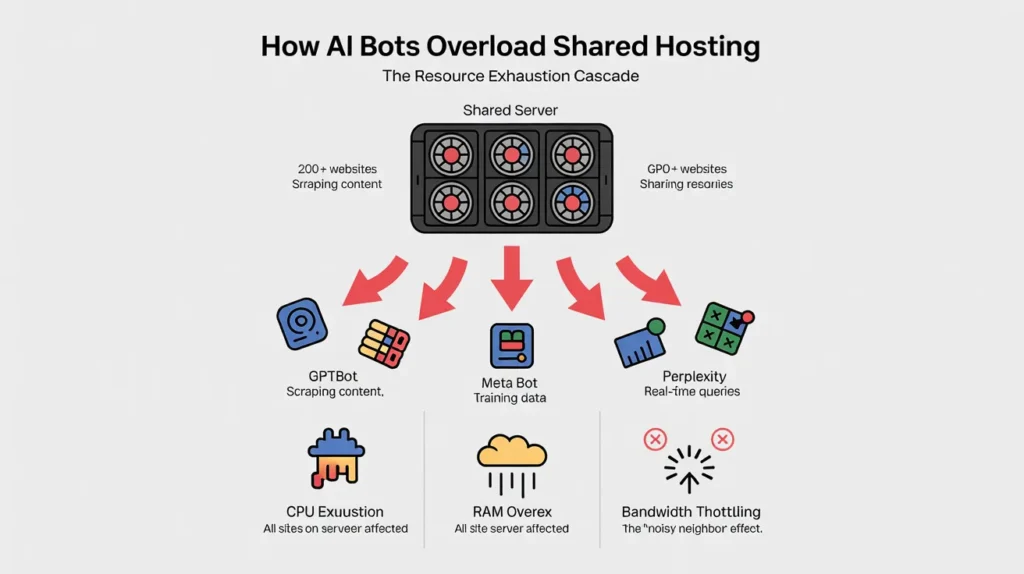
More recently, operators have observed increased use of so‑called user‑action crawlers. These agents execute JavaScript, traverse sites deeply, and behave less like indexers and more like persistent users. The result is higher computational load, greater bandwidth consumption, and increased pressure on services that were never designed for sustained interaction at that intensity (Skynet Hosting, 2026).
Taken together, these measurements point to a qualitative change, not merely a quantitative one. This is a structural shift in how the internet is consumed. It cannot be explained as a transient abuse pattern or a short‑term anomaly.
A Familiar Transition
This moment is best understood not as an isolated technical problem, but as part of a broader platform transition. The last time the software industry experienced a shift of comparable scope was with the rise of the web browser.
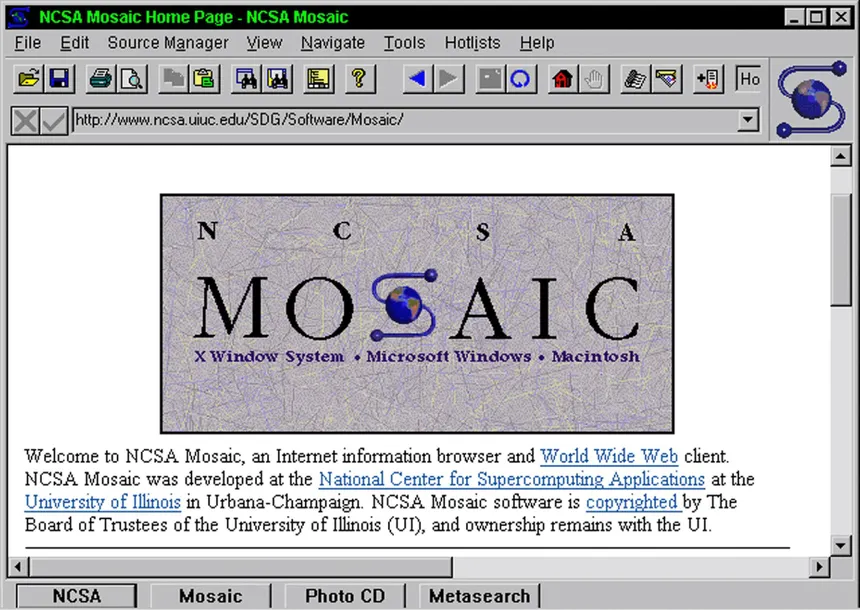
The browser did not become dominant because enterprises planned for it. Users moved first, and the industry followed. Desktop software, client server architectures, local storage, and LAN-centric workflows all had to be rethought as applications, data, and services migrated to the web. The critical change was not simply technical, but behavioral. People adopted the browser as a primary interface to information while institutions were still grappling with immature tooling, unsettled patterns, and practices that had not yet solidified. A similar pattern is now visible with AI interfaces, which increasingly displace search, navigation, and discrete applications as the way people access information and analysis.
Alongside commercialization, the browser era also produced something less intentional but deeply consequential. It created a durable open commons. In geospatial terms, this included OpenStreetMap, open tile services, free geocoding APIs, and openly licensed spatial datasets. These were not the primary objective of the web. They emerged as a byproduct of lowered barriers to participation and distribution. Over time, they became critical infrastructure, quietly supporting disaster response, humanitarian mapping, navigation, research, and urban planning worldwide. The AI era did not begin from a blank slate, but inherited this infrastructure.
This analogy, however, is imperfect. During the browser transition, the costs of architectural misalignment were offset relatively quickly by visible benefits. New capabilities appeared fast enough that those bearing the costs could see what the transition delivered in return. With AI, the situation is different. The costs imposed on open geospatial infrastructure are immediate and measurable. Bandwidth is consumed, services degrade, and hosting bills rise. The benefits to the communities supplying that data are not yet visible or directly accessible. This may prove to be a timing issue rather than a permanent condition, but timing matters.
The difference can be understood in terms of production and participation. The web lowered barriers to creation and expanded who could meaningfully contribute. Participation was centrifugal, spreading outward and enabling a broad population to shape the commons itself. AI inverts that dynamic. Access at the interface layer appears widely available, but meaningful participation in production is increasingly concentrated among a small number of well-resourced organizations. The open geospatial commons now functions as high-value input into systems that most of its contributors cannot influence.
The result is a structural mismatch. Open geospatial infrastructure was built around human-scale assumptions. People browse maps, issue queries, contribute data, and reuse information incrementally. That same infrastructure is now absorbing machine-scale demand without having opted into that role. Unlike past platform transitions, the institutions under strain are largely volunteer-run and nonprofit. They do not resemble the commercial incumbents that navigated earlier shifts with balance sheets, contracts, and legal leverage.
This structural mismatch, rather than bad actors or bad intentions, provides the context in which the current stresses on the open geospatial commons should be understood.
Infrastructure Built for Humans, Not Machines
The structural mismatch described above is not abstract. It manifests in concrete operational stresses across the open geospatial web, particularly in services that were designed to prioritize openness, accessibility, and modest human use.
Most open geospatial services were built around familiar interaction patterns. People browse maps, pan and zoom, make occasional API calls, download data incrementally, and contribute improvements over time. Capacity planning, rate limits, and funding models evolved around these behaviors. They assume variability, bursts of interest, and long periods of relatively stable demand. They do not assume continuous, high‑frequency access at machine scale.
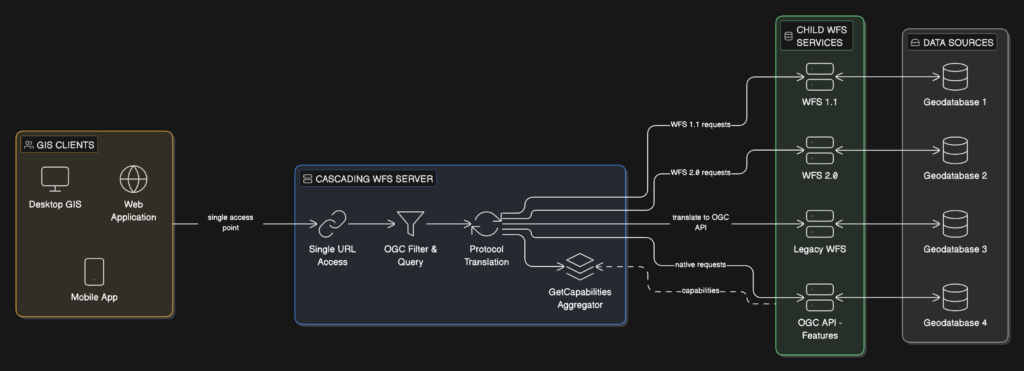
It is important to acknowledge a technical nuance. OGC specifications and related standards did anticipate system‑to‑system interoperability, including service‑to‑service access and automated workflows (Open Geospatial Consortium, n.d.). Machine clients and automated integrations have long been part of the geospatial ecosystem. What those specifications did not anticipate was AI‑scale consumption. Training and agent‑based systems operate continuously, generate sustained high volumes of requests, and impose load profiles that differ fundamentally from both human use and traditional machine‑to‑machine integration.
The economic consequences of this shift are immediate. Sustainability for open geospatial infrastructure depends on volunteer labor, donated resources, modest grants, and thin free tiers offered by commercial operators. These business models were never designed to absorb persistent industrial‑scale demand. As automated access increases, costs rise quickly, often without corresponding benefits that could offset those expenses.
Operationally, existing assumptions break down. Quotas are exhausted, hosting bills escalate, and services are forced to introduce defensive controls that were never intended to be permanent. Longstanding conventions such as robots.txt and polite crawl rates offer limited protection when faced with modern crawlers that ignore, evade, or work around them (Bakare & Saner, 2026; Slashdot, 2025; Kim et al., 2025).
The result is a gradual erosion of openness. Services throttle aggressively, restrict access, or go offline entirely. These outcomes do not reflect a shift in values or intent. They are responses to accumulated operational strain.
This is how structural pressure becomes enclosure, not through policy or principle, but through necessity.
Where GeoAI Is Focused
Much of the current conversation in the geospatial industry is oriented toward what can be built with AI. Conferences, publications, and vendor roadmaps emphasize digital twins, large-scale inference, agent architectures, and the evolution of standards to support these applications (Geospatial World, 2026; Spatialists, 2026). The focus is on capability, performance, and competitive advantage, which is valid and understandable.
What receives far less sustained attention is the condition of the data and infrastructure these systems depend on. Discussions of model architectures and downstream applications often proceed as if access to open geospatial data is stable, inexpensive, and effectively infinite. Questions of load, cost recovery, and long-term sustainability are treated as operational details rather than first-order constraints.
This imbalance is not unique to geospatial. Other open-source communities are beginning to confront similar dynamics as AI-driven consumption outpaces the assumptions under which their infrastructure was built. In many cases, those communities are now debating governance, funding, and access controls that would have seemed unnecessary only a few years ago. By comparison, the geospatial sector has been slower to engage with these questions directly.
The result is a growing disconnect. The community advancing GeoAI increasingly draws on an open geospatial web that it does not directly operate, fund, or, in many cases, visibly encounter. That disconnect does not reflect indifference or bad faith. It reflects a gap between where innovation attention is concentrated and where structural stress is accumulating.
Achieving Sustainability
If the pressures described above are structural rather than incidental, then responses must extend beyond isolated technical fixes. A more sustainable path will likely involve a combination of engineering measures, evolving norms, and institutional engagement, each with its own limitations and trade-offs.
From a technical perspective, operators are already experimenting with measures intended to better distinguish automated agents from human users. Improved rate-limiting, traffic classification, and selective use of proof-of-work or challenge-response mechanisms can reduce some forms of large-scale automated access (Slashdot, 2025). Greater coordination among operators of open tile and API services may also help reduce redundant crawling and blunt the worst amplification effects.
These approaches, however, are not without cost. Techniques that are effective at slowing or deterring automated extraction can also introduce friction for people. Latency increases, traditional integrations break, and access becomes more difficult for users behind shared networks or operating under bandwidth and accessibility constraints. The resulting tension is a consequence of the same structural mismatch described earlier, in which efforts to protect open infrastructure can make it less open for the people it was originally designed to serve.
For that reason, technical controls alone are unlikely to be sufficient. There is growing need for clearer norms around reciprocal responsibility when open geospatial data is used at scale, particularly for model training and agent-based systems. Shared-crawl or aggregation models that reduce redundant load offer one possible direction. In this approach, large-scale consumers rely on coordinated, shared retrieval of open data rather than independently crawling the same sources repeatedly, drawing lessons from how broader web infrastructure has evolved to manage similar pressures (Fastly, 2025).
Finally, questions of governance and funding cannot be avoided. Organizations such as OSMF, OSGeo, and OGC may have roles to play in clarifying acceptable usage patterns and expectations, even if enforcement remains decentralized. At the same time, funders and sponsors must recognize that crawler mitigation has become a core operational concern rather than an edge case. Sustaining the open geospatial web in an AI-driven environment will require acknowledging these costs explicitly and deciding, collectively, how they are borne.
Implications and Questions
The experience of Vaguely Rude Places was modest in scale, but most things on the geospatial web are modest in scale, which is precisely why it was instructive. A single volunteer‑maintained project ran out of capacity and went dark, not because of a technical flaw, but because a new pattern of use that exceeded existing capacity planning asserted itself.
Similar pressures are now being reported by maintainers of foundational geospatial infrastructure across the open geospatial web. These systems have delivered extraordinary public value over decades. They underpin navigation, research, emergency response, and countless downstream applications. Their continued availability has long been treated as a given.
That assumption is becoming harder to sustain. As GeoAI matures, consumption of open geospatial data is increasing rapidly, while the structures that fund and operate that data remain largely unchanged. The question is not whether this infrastructure is valuable. That case has already been made.
The more difficult question is whether the current arrangement is viable over the long term. As the industry builds increasingly powerful systems on top of the open geospatial commons, it is reasonable to ask, openly and constructively, who is bearing the cost of the map, and whether that burden is aligned with the value being created.
References
Bakare, M., & Saner, E. (2026, February 24). AI bots like ChatGPT may force end of the internet as we know it. openDemocracy. https://www.opendemocracy.net/en/ai-chatbots-scraper-bots-chatgpt-website-offline-change-internet/
Fastly. (2025, August). New Fastly threat research reveals AI crawlers make up almost 80% of AI bot traffic, Meta leads AI crawling as ChatGPT dominates real-time web traffic [Press release]. https://www.fastly.com/press/press-releases/new-fastly-threat-research-reveals-ai-crawlers-make-up-almost-80-of-ai-bot
Gale, G. (2026, February 21). (AI) bots ate my map tiles. vicchi.org. https://www.vicchi.org/2026/02/21/ai-bots-ate-my-map-tiles/
Geospatial World. (2026, February). Optimization of AI, automation, and digital twins – transforming utilities and network management [Video]. GeoBuiz Summit 2026. https://geospatialworld.net/videos/
Heise Online. (2026, January 28). OpenStreetMap is concerned: Thousands of AI bots are collecting data. https://www.heise.de/en/news/OpenStreetMap-is-concerned-thousands-of-AI-bots-are-collecting-data-11157359.html
Open Source For You. (2026, January 5). Open source content drained by AI bots while human traffic collapses, Cloudflare finds. https://www.opensourceforu.com/2026/01/open-source-content-drained-by-ai-bots-while-human-traffic-collapses-cloudflare-finds/
Skynet Hosting. (2026, January 14). The 2026 AI bot impact report: Shared hosting risks & solutions. https://skynethosting.net/blog/ai-bot-impact-report-in-shared-hosting/
Slashdot. (2025, March 26). Open source devs say AI crawlers dominate traffic, forcing blocks on entire countries. https://tech.slashdot.org/story/25/03/26/016244/open-source-devs-say-ai-crawlers-dominate-traffic-forcing-blocks-on-entire-countries
Spatialists. (2026, February 22). AI-ready OGC standards. https://spatialists.ch/posts/2026/02/22-ai-ready-ogc-standards/
Cloudflare. (2025, August 28). AI crawler traffic by purpose and industry. https://blog.cloudflare.com/ai-crawler-traffic-by-purpose-and-industry/
Kim, T., Bock, K., Luo, C., Liswood, A., Poroslay, C., & Wenger, E. (2025). Scrapers selectively respect robots.txt directives: Evidence from a large-scale empirical study. arXiv. https://arxiv.org/abs/2505.21733
Open Geospatial Consortium. (n.d.). How OGC’s standards program works. https://www.ogc.org/how-our-standards-program-works/
Header image: Iwoelbern, CC BY-SA 3.0 https://creativecommons.org/licenses/by-sa/3.0, via Wikimedia Commons
