I first saw the typewriter when I rolled up the door of the shed. That small shed with the gabled roof and T-111 exterior had been there since the mid-1990s. My father built it with two sections. One was for his workshop and the other was intended to be my mother’s sewing room. I’m not sure how much she ever used it for that as she always did her sewing and quilting in the house, but Dad’s side saw more than its share of use.
I recall helping my dad put the roof on that shed. It was one of the few times I ever remember him calling me and asking for my help. We needed to install the rafters so that he could put the sub-roofing and shingles on later. The rafters were a two-person job, so my wife and I went down on a Saturday and I helped him put the pre-fab rafters in place. He showed me how to toe-nail them and we alternated between holding each rafter in place and nailing our respective ends in place.
It was a hot, sunny day and the work was sweaty. Mom and my wife made dinner, which was the glorious fresh fare of summer. I don’t recall if we spent the night or if we went home in the evening. I do recall that it was a really good day.
My father was imbued with the ability to fix anything, especially anything mechanical. He was not imbued with patience and anyone of lesser ability was given very little margin for error. That particular trait was directed at me on more than one occasion and, as a result, I am not imbued with the ability to fix much of anything. I would not say that my relationship with my father was strained. It was mostly flat. We lived in the same house and, occasionally, he’d ask me about school or something. Any lessons I learned from him came by observation and wouldn’t sink in until many years later.
Most weekends he spent in the garage fixing up some project car that he had picked up off the lemon lot, but I was never invited to participate. That was clearly “his time.” I eventually discovered computers and, while he never understood them, he did understand that I had a talent with them and seemed happy about that. During my teen and college years, I’d say our relationship was one of quiet detente. We didn’t have much to say to each other, but I had gotten used to that by then so it didn’t yield any consternation.
Through those teen and college years, when most people I know were benefitting from wisdom imparted by their families of origin, I was just trying to figure it out in the absence of any such wisdom from my own. As I matured, I was increasingly able to perceive that gap in relief as my peers just seemed to possess basic life skills that, I learned, came from their families. In order to avoid the resentment I felt building, I developed thick defense mechanisms so I wouldn’t need anything. Those same defense mechanisms made it so that I did not readily communicate my feelings.
Years passed, my wife and I got married, had kids and built our life. I began to realize, with the help of therapy, that my defense mechanisms had congealed into habit and that they were causing me to have trouble connecting to my emotions and, consequently, to those I care about. The pattern was repeating itself. The work to break that pattern continues to this day.
During this time, I also began to tackle my latent ADHD which, as I got older, was transforming from a superpower into a liability. Balancing multiple lines of thought on a constant basis becomes exhausting over the course of a lifetime and those lines begin to fray. I began working on systems to adjust how I approach work and life.
Doing this work made me more observant and I began to recognize the same patterns in my father over the course of our life together. He was born during the Depression and grew up in a time that did not have a common language or understanding to recognize forms of neurodivergence.
My father could hyperfocus on a task and would lose interest as soon as the challenging part was done. That could be why, as a young driver, my car was mechanically perfect but with the body work of a wrecking yard. Seeing him grow more frustrated with overstimulation, become less able to sit through a movie, and seek solace working quietly in his workshop showed me he was working on his own systems, even if he may not have been aware of it.
Key to that was tinkering. His mind was always going so his hands needed to be as well. As he aged, he no longer had the physical stamina to work on cars, though he kept trying. Over time, he gravitated to smaller projects, such as lawn mowers and motorcycles.
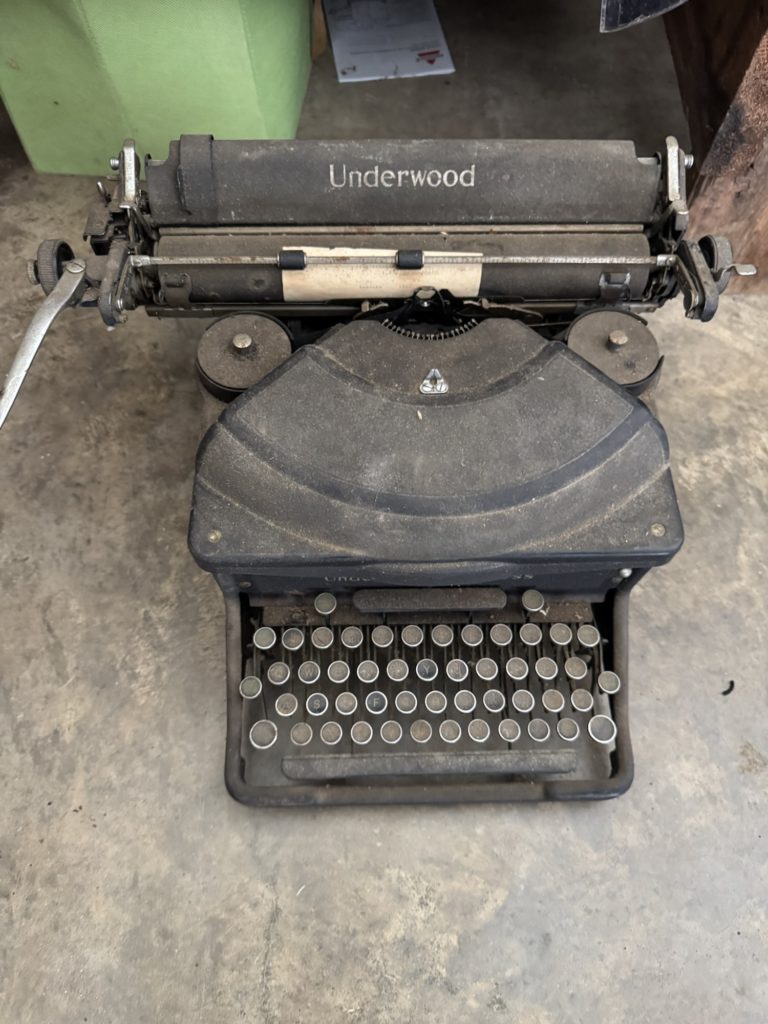
Which brings me to the typewriter. It was an old Underwood mechanical model of the kind found in offices everywhere in the first half of the 20th century. The keys worked, raising arms and striking the ribbon. Next to it were pieces of two others, clearly used for parts to make the working one in front of me. Nearby were also a couple of old mechanical cash registers, evidence of a project never finished.
These mechanical devices are remarkably complex and intricate. They represented a mind in motion until the very end. They also represented a mind and body in decline, because around them lay the tools he had been using. This would not have happened in his prime. Every tool would have been returned to its place but, nearing the end of his life, fatigue would set it and he would just leave them where he set them.
A couple of weekends ago, the concept for a climate risk API came into my head. I spent chunks of that weekend building a prototype. Once it was in my mind, I had to put my hands on the keyboard.
His medium was mechanics. Mine is software, but the need to build is not very different. In its silent state of incompleteness, that typewriter gave me a view into the workings of his mind and helped me understand him better in a way that words never did.
