I am an inveterate infrastructure geek due to work I did earlier in my career in critical infrastructure protection. One of my projects was to build a system to model the behavior of commercial freight rail. Of course, I am also a programmer. Between railroads and writing software to model them, it was impossible to avoid dealing with time zones, so I inevitably also turned into a time zone geek. If you join me in that elite club, then 2026 is shaping up to be our year.
This October, the General Conference on Weights and Measures, the world’s authority on measurement, will decide how quickly civil time should stop chasing the uneven rotation of the Earth. The immediate problem is that the planet has recently been rotating fast enough to raise the possibility of the first negative leap second. Adding an occasional second is already disruptive. Removing one, something no production timekeeping system has ever had to do, is considerably worse.
You can be forgiven if you haven’t heard about that vote. But all of my social feeds have blown up in celebration/outrage that the U.S. House just passed the Sunshine Protection Act, permanent daylight saving time, and sent it to the Senate. So in 2026 time is on the ballot twice, once for the physicists and once for the politicians, and both votes turn on the same old question. Should the clock serve the sky, or should it serve us?
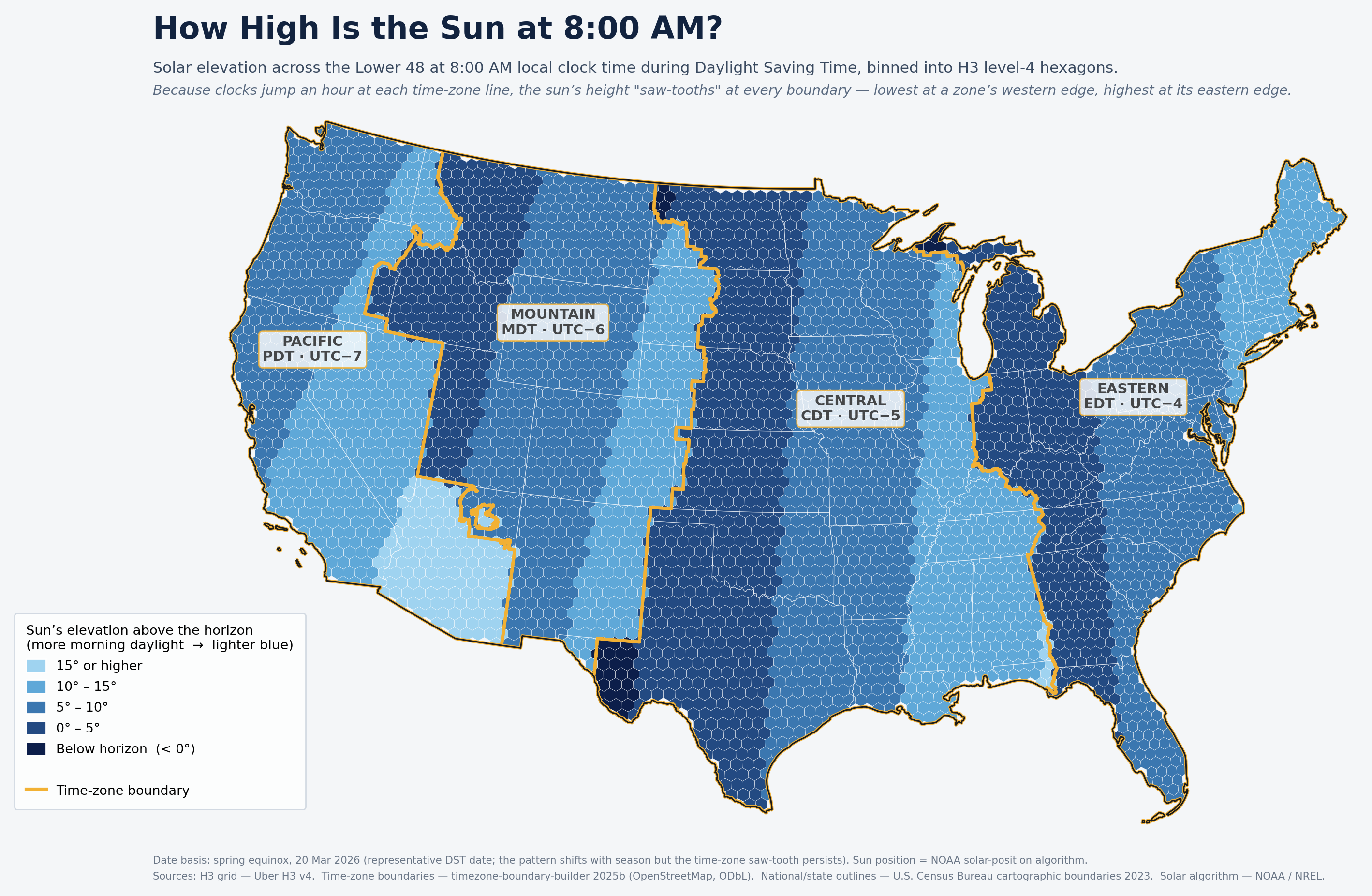
In our modern world, time zones have become a fact, like coastlines. They are nothing of the sort. They are infrastructure, invented and contested and bent by politics like any border, and that is exactly why they are the one piece of geography that reaches into your calendar and reschedules your life.
Every place once kept its own time. Noon was whenever the sun stood highest overhead, and since the sun crosses a degree of longitude every four minutes, the next town over was always a little off from the previous one. This worked for thousands of years, right up until railroads made it possible to travel faster than a horse.
You can’t run a single-track timetable when every station’s clock disagrees; you get missed connections and, worse, head-on collisions. So the railways standardized before governments did. Britain’s Great Western Railway went on to London time in 1840. North America’s problem was continental, with some eighty rival timetables in play by the 1860s, and the fix was pure corporate fiat. At noon on November 18, 1883, American and Canadian railroads switched the whole continent onto four zones. The newspapers called it “the Day of Two Noons.” No legislation, public policy, or standards body behind it. The railroads solved their own problem, carved up the map, and assumed the public would fall in line. Mostly it did, because the railroad was everyone’s link to the wider world. The Federal Government didn’t get around to making time zones legal until 1918, thirty-five years after the railroads created them.
From there, the concept spread around the world. An engineer I worked with in my infrastructure days explained to me that, in 1884, delegates from twenty-six nations convened the International Meridian Conference in Washington and divided the world into twenty-four time zones. That version of the story is still very easy to find, but it’s not what really happened. What they actually did was settle on Greenwich as the prime meridian, the zero point for longitude, and they settled on it for the thoroughly unromantic reason that two-thirds of the world’s ships already ran on charts drawn from it. Install base beat elegance long before software existed. (France, aggrieved, held out for decades. When it finally brought its clocks onto Greenwich in 1911, the law pointedly refused to say so, defining French time instead as “Paris Mean Time, retarded by nine minutes and twenty-one seconds.”)1
But time zones themselves? Those the conference dodged. It blessed a “universal day” and essentially stated that it was not intended to interfere with anyone’s established local time. Sandford Fleming, an engineer who had campaigned hardest for a worldwide grid of zones, was told, more or less, that it was none of the conference’s business. The meridian was fixed in 1884. Time zones arrived later, and slowly, one country at a time, over the next fifty years.
Time zones eventually spread across the world, but they never became the clean global grid Fleming imagined. If they had truly followed the sun, the map would be a set of tidy vertical stripes. Instead, we have this.
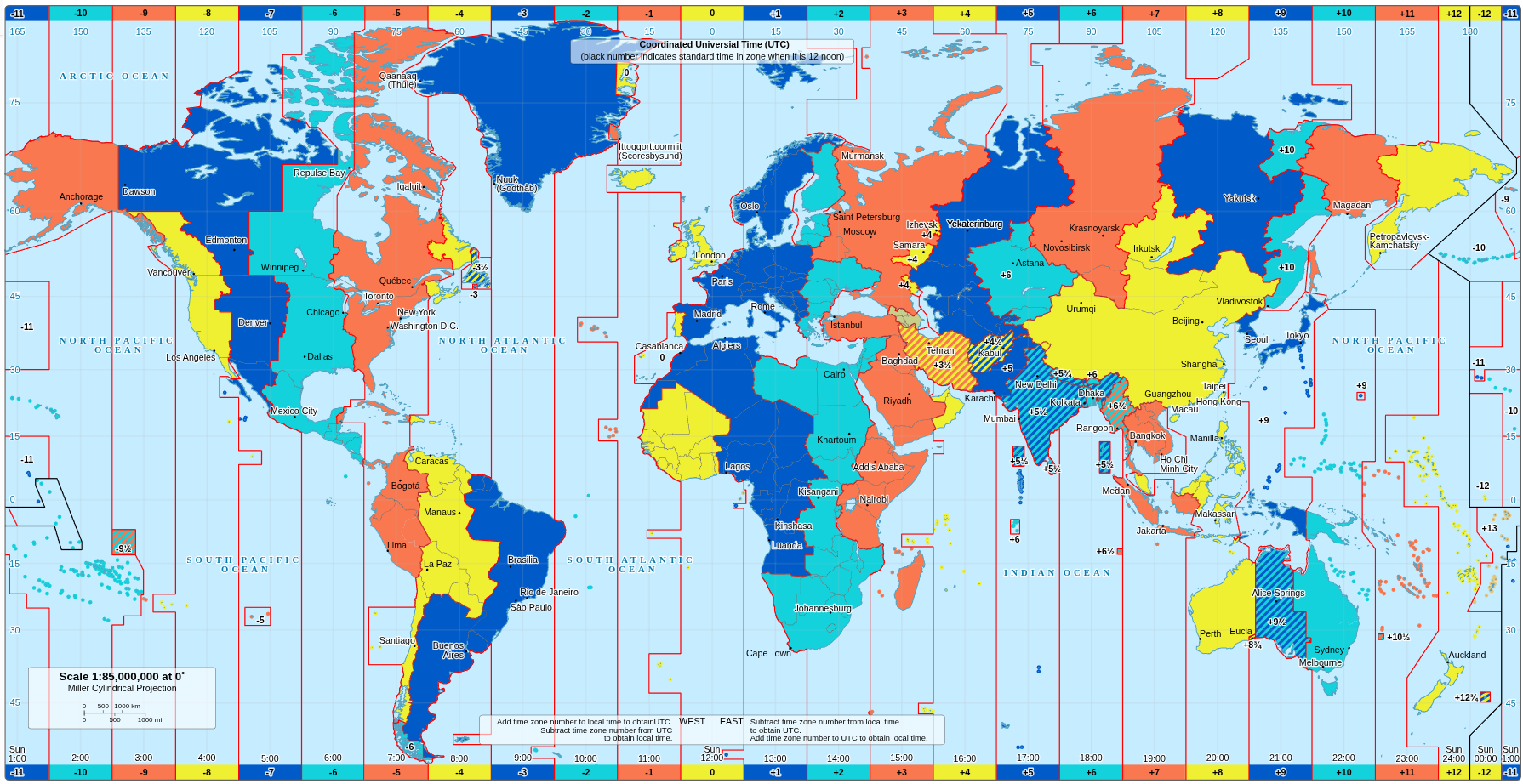
China spans five geographic zones and observes exactly one, Beijing time, imposed in 1949 to project unity across the whole country. So in western Xinjiang the sun reaches its peak in what the official clock insists is mid-afternoon, and locals keep an unofficial “Xinjiang time,” two hours behind Beijing, for ordinary life, while reserving Beijing time for anything official. Two clocks, one country. India sits half an hour off the hour. Nepal sits forty-five minutes off, its clock pinned to a meridian near a sacred Himalayan peak and set a deliberate fifteen minutes apart from India, because a time zone is a cheap and permanent way to say we are not you.
And the International Date Line, that jagged frontier down the Pacific, was never fixed by any treaty, so countries simply move it when it suits them. In 1995 Kiribati, fed up with the line running straight through the middle of its own territory, shoved it a thousand kilometers east, inventing UTC+14 in the process and handing its easternmost island the honor of being first on Earth to greet each new day. In 2011 Samoa jumped the opposite way and struck December 30th from the calendar entirely, so its working week would line up with Australia and New Zealand. A whole day, gone by legislation.
Which is more or less what Congress is now weighing, one hour at a time. Daylight saving started life as a fuel-saving measure in the First World War and has survived mostly as a twice-a-year argument. On the narrow question of whether to stop moving the clocks at all, Americans mostly agree that we should end that silliness. But agreeing to stop is not the same as agreeing where to stop, and where to stop is a question of geography.
Permanent daylight time doesn’t manufacture daylight. It only moves an hour of it out of the morning and into the evening. In summer, nobody minds. In winter, when there’s barely enough daylight to go around, you end up borrowing against the dark end of the morning, and just how dark that morning gets depends on where you sit inside your zone. The farther west you are, the later your sun already rises, and permanent daylight time nudges the entire country another step west. Call it the Xinjiang problem, relocated to Ohio. We know roughly how it goes, because we’ve run it once already. The country locked itself onto permanent daylight time in January 1974, watched children stand at bus stops in 0900 darkness, and repealed a two-year plan within ten months. That memory may be why the Senate, which waved an identical bill through by unanimous consent back in 2022, has turned into the cautious chamber.
It keeps coming back to infrastructure. Railroads were the internet of their day, which is fitting because the internet plays such a pivotal role in maintaining time and time zones today. Every one of the facts discussed here, from each offset to each daylight-saving rule to each of Kiribati’s changes of heart, and whatever the Senate finally settles on, has to be written down somewhere your devices can go and read it. That somewhere is the IANA Time Zone Database, a public-domain file that sits underneath nearly every operating system, programming language, and server on the planet.
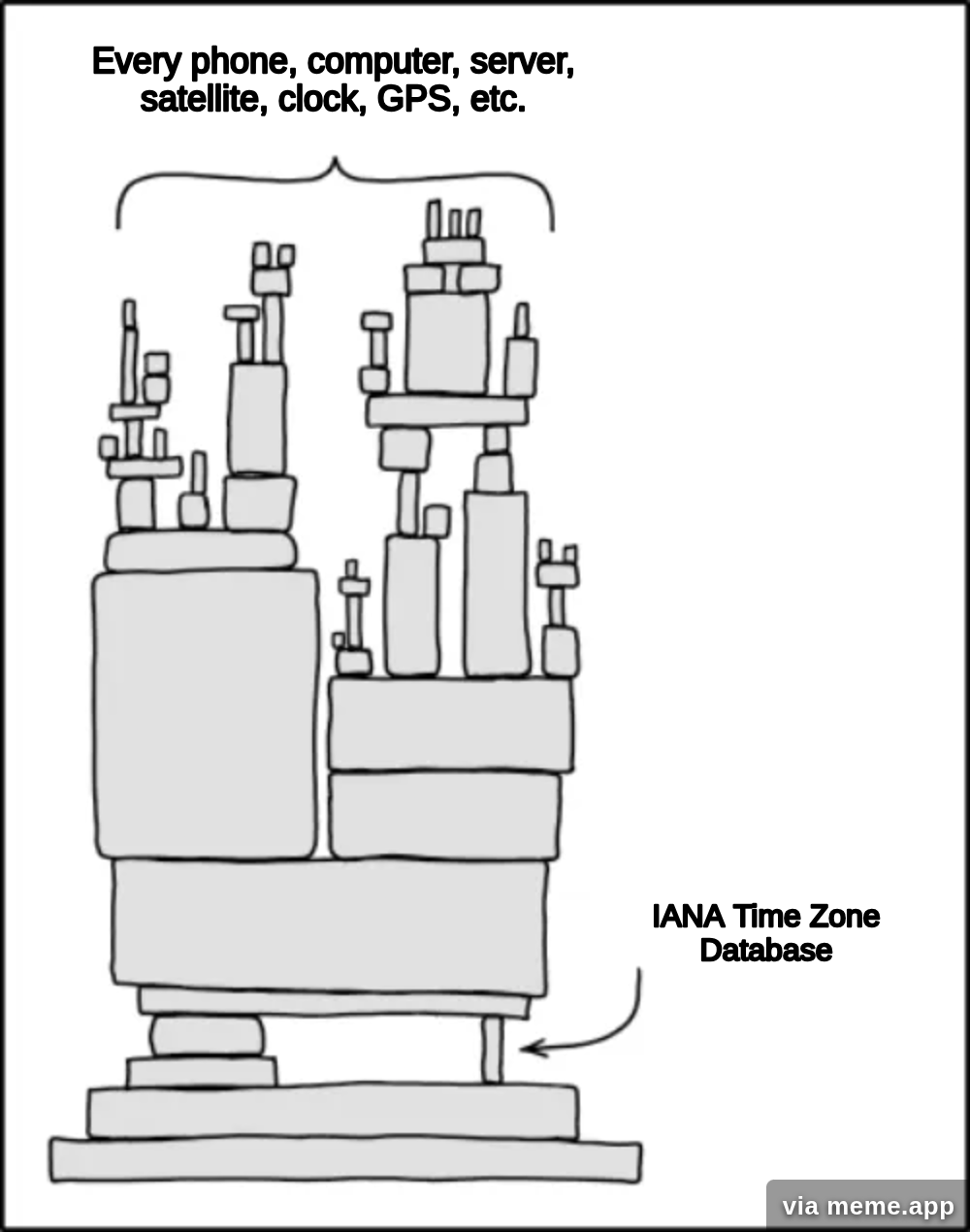
One person built it, at the U.S. National Institutes of Health, back in the 1980s. It is looked after today mostly by volunteers on a mailing list, working by rough consensus, with no treaty, no budget, and no owner standing behind them. When some government somewhere changes its clocks by decree, which happens more often than you’d think, a handful of people have to notice, argue it out, and ship an update before the change goes live. The most load-bearing piece of timekeeping infrastructure on Earth is, when you get down to it, a group project held together by goodwill. If the Sunshine Protection Act becomes law, the thing that makes it true on your phone will be those volunteers, pushing a release. This is perhaps the most critical open-source project in the world.
We love to hate time zones because they mark the precise spot where a clean idea runs headlong into a messy species. The clean idea is the grid. Simply slice the planet into hourly strips and be done. The species won’t cooperate. It keeps interrupting with borders and national pride and trade routes, with a sacred mountain, a revolution, an oil crisis, and a six-year-old in Ohio who would rather not wait for the school bus in the dark.
Every one of those irritations, the 6 a.m. call, the jet lag, the hour stolen each March, the “hang on, is that your Tuesday or mine?”, is a small standoff between physics and politics that somebody, somewhere, once settled with a compromise you never got a vote on.
That is not a flaw in the system. That is the system. In 2026 we get to watch two of those old compromises pried back open at the same time. A group of physicists deciding whether to stop chasing the Earth’s spin, and a room of senators deciding whether to haul the winter sun into the evening and gamble that we’ve all forgotten 1974.
I have been remarking lately on how human geography is the messy, uncooperative layer on top of the (often maddeningly complex) physics of physical geography. I don’t think I could have found a better example of that concept than two committees tweaking time and deciding how much say the sun still gets.
Notes
- France legally adopted GMT on 9 March 1911 but defined it as “Paris Mean Time, retarded by 9 minutes 21 seconds,” avoiding the word “Greenwich”; this remained French legal time until 1978. See Richard J. Evans, The Pursuit of Power: Europe 1815–1914 (Penguin, 2016).
Further reading
A few reliable places to go deeper, roughly in the order the essay touches them:
- Whose Time Is It Anyway? A Brief History of Standardized Time Zones in the United States — Library of Congress. How the railroads and the telegraph forced standard time on the country, the Dowd and Allen proposals, and the Day of Two Noons.
- International Meridian Conference — Wikipedia. A well-sourced account of the 1884 conference, with the resolutions themselves and the often-missed fact that it explicitly declined to create time zones.
- Guidance Bulletin No. 31: International Dateline — U.S. Department of State, Office of the Geographer and Global Issues. The government’s own instructions for redrawing the date line after the Kiribati and Samoa moves, turning coordinates and all.
- The Time Zone Database — IANA. The primary source: the actual tz/zoneinfo database, its coordinators, and how changes are proposed and shipped. Pair it with the readable tz database overview on Wikipedia.
- 28th Meeting of the CGPM (2026) — Bureau International des Poids et Mesures. The official page for the October 2026 conference where the leap-second question sits. For the plain-English version, see International Timekeepers to Vote on Changing the Leap Second to a Leap Hour in Scientific American.
- H.R.139 — Sunshine Protection Act of 2025 — Congress.gov. The bill text and its current status, straight from the source.
- What Happened the Last Time the U.S. Tried to Make Daylight Saving Time Permanent? — Smithsonian. The 1974 experiment, the dark winter mornings, and why it lasted ten months.
Header image: Petar Milošević, CC BY-SA 4.0 https://creativecommons.org/licenses/by-sa/4.0, via Wikimedia Commons
