[Author’s Note: At the time of this writing, I am a member of the OSM US Advisory Council. This post reflects my personal analysis and opinion. It has not been endorsed by OSM US, and is not intended to reflect their views.]
Recently, a proposal submitted to the Open Geospatial Consortium (OGC) set off a thoughtful discussion within the open geospatial community. At issue is the idea of a global identifier system for real‑world geographic entities, which is something that would make it far easier to align data across the many datasets practitioners work with every day. The discussion that followed, including comments from the OpenStreetMap Foundation, is not unusual for infrastructure standards. It reflects a familiar tension between the technical appeal of shared identifiers and the practical realities of how diverse data ecosystems evolve.
The OGC GERS Proposal
The proposal itself requests that the Open Geospatial Consortium (OGC) consider the Global Entity Reference System (GERS) within the OGC standards process (Open Geospatial Consortium, 2025). The proposal references work associated with the Overture Maps Foundation and outlines a system for assigning persistent identifiers to real‑world geographic entities. In practical terms, the identifiers would provide stable references for features such as buildings, roads, and places (Open Geospatial Consortium, 2025; Overture Maps Foundation, n.d.).
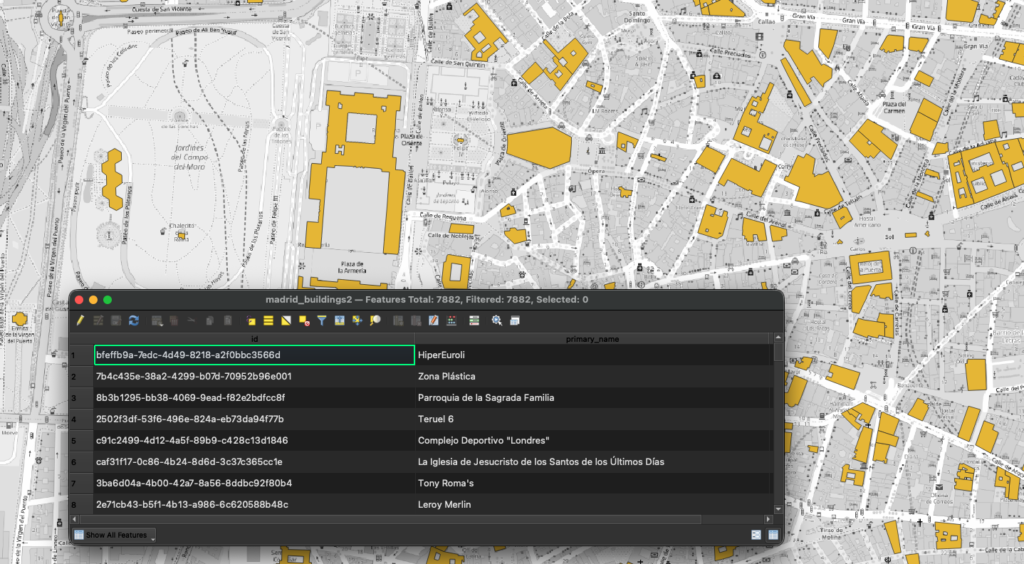
The proposal describes the goal of GERS in straightforward terms: allowing datasets from different providers to reference the same real‑world entities using common identifiers (Open Geospatial Consortium, 2025). Instead of repeatedly reconciling features across datasets, a shared reference identifier could be associated with geographic features across multiple data sources (Overture Maps Foundation, n.d.). Anyone who has spent time integrating geospatial data will immediately recognize the appeal of that idea.
OSM Foundation Comment
Following the submission of the proposal, the OpenStreetMap Foundation (OSMF) provided a formal comment in the OGC request discussion. The comment focused on the implications of standardizing a global identifier system that is closely associated with a specific dataset ecosystem. In particular, the OSMF noted that GERS identifiers are derived from the Overture reference dataset and expressed concern that formalizing the system through the OGC standards process could implicitly position that dataset as a global reference framework for geographic entities (OpenStreetMap Foundation, 2025).
The OSMF response emphasized something many practitioners already understand: standards processes should remain neutral with respect to individual datasets and governance models. The concern raised was that adopting a standard tied to a particular dataset’s identifier system could create incentives for other data providers to align with that dataset simply to achieve interoperability. In other words, the issue is not the usefulness of identifiers, but the implications of anchoring them to a single dataset (OpenStreetMap Foundation, 2025).
The OSMF comment also suggested an alternative conceptual approach. Rather than standardizing a global identifier system derived from a single dataset, the foundation proposed focusing on mechanisms that allow multiple datasets to publish and maintain their own identifiers while enabling cross‑references between them. In this model, standards would describe how identifier systems interoperate or map to one another, rather than establishing a single global registry of identifiers for geographic entities (OpenStreetMap Foundation, 2025).
Identifier Systems and Standards
Seen in isolation, this debate might appear unique to geospatial data. In reality, it follows a pattern that has appeared many times in other technical domains. Whenever a global identifier system is proposed, the discussion tends to revolve around the same questions: who governs the identifiers, how neutral the system is, and whether standardization implicitly elevates one implementation over others.
A familiar example is the Domain Name System (DNS). DNS provides the shared identifier layer that allows independent networks and services to interoperate across the internet. Its globally coordinated registry is administered through institutions such as the Internet Corporation for Assigned Names and Numbers (ICANN) (ICANN, n.d.; Mockapetris, 1987). While the system has proven enormously successful, its governance structure has long prompted discussion about neutrality, control of the root registry, and the institutional authority behind globally recognized identifiers (Mueller, 2002).
Another example comes from scholarly publishing through the Digital Object Identifier (DOI) system, administered by organizations such as the International DOI Foundation and registration agencies like Crossref (International DOI Foundation, n.d.; Paskin, 2010). DOIs allow publications from many different publishers to be referenced consistently across the academic ecosystem. As with DNS, the system works because it simplifies interoperability, but it also illustrates how global identifier systems inevitably become associated with specific governing organizations and operational frameworks.
Viewed in this light, the exchange between the OGC proposal and the OSMF comment looks less like an isolated issue and more like a familiar infrastructure discussion which may be indicative of the continued maturation of the geospatial domain. On one side is the clear technical benefit of shared identifiers. On the other is the equally legitimate concern about governance, neutrality, and how such systems shape the broader ecosystem of data providers.
Thoughts
Like many geospatial professionals, I have worked with OGC specifications for years. Similarly, I have used OSM data in consulting projects for commercial and government customers for many years. More recently, I have been integrating Overture data into several projects. For many practitioners, OGC and OSM are simply foundational, and Overture is quickly becoming so. Triangulating between the three is a daily fact of life.
I have written a number of times about my past work on the inception of HIFLD. It was originally conceived to ensure that all stakeholders working on critical infrastructure issues could be confident they were looking at, analyzing, and discussing the same assets during an event or project. At times, we simply deferred to a commercial provider, such as Navtech/Navteq/HERE, and used their identifiers for assets. More often, however, we had to build cross‑reference tables to map identifiers across datasets.

Ironically, the emergence of OSM triggered a need for this. We had been standardized on HERE street data for several years, and it had far better coverage than OSM early on. However, the quality of OSM data, where it existed, could not be ignored.
There were numerous times when a canonical, global identifier would have made our lives easier, and I remain sympathetic to the call of its siren song. But in practice it is not workable. Many industries have standardized identifiers within their domains. Take, for example, ICAO and IATA codes in the air traffic industry (International Civil Aviation Organization, n.d.; International Air Transport Association, n.d.). These cannot be ignored if we wish to interact meaningfully with those industries.
In the end, I think that the remedy proposed by OSMF is the only practical solution here. I also think it aligns most closely with the interoperability mission of OGC. The real interoperability issue here is not the features on the ground, but the primary keys used to identify them. That is exactly OGC’s sweet spot.
Ultimately, I think all three participants in this discussion (OGC, Overture, and OSMF) are correct. Overture is correct that a universal identifier like GERS would be useful. OGC is correct that such a thing should be considered as a standard. OSMF is correct that one identifier to rule them all is not practical. Each is approaching this issue in good faith, without hyperbole and without the “culture war” framing that can sometimes overtake these discussions.
One thing I learned during the HIFLD years is that it is possible for a diverse community, often with conflicting points of view, to come together to solve important problems. I am confident the same can happen here.
References
Open Geospatial Consortium. (2025). Request for consideration: Global Entity Reference System (GERS). https://github.com/opengeospatial/requests/issues/3
Overture Maps Foundation. (n.d.). Global Entity Reference System (GERS). https://docs.overturemaps.org/gers/
OpenStreetMap Foundation. (2025). Comment on “Request for consideration: Global Entity Reference System (GERS)”. https://github.com/opengeospatial/requests/issues/3#issuecomment-3988672794
ICANN. (n.d.). About ICANN. https://www.icann.org/resources/pages/welcome-2012-02-25-en
International DOI Foundation. (n.d.). The DOI system. https://www.doi.org/the-identifier/what-is-a-doi/
Mockapetris, P. (1987). Domain names—Concepts and facilities (RFC 1034). Internet Engineering Task Force. https://doi.org/10.17487/RFC1034
Paskin, N. (2010). Digital Object Identifier (DOI®) system. In M. J. Bates & M. N. Maack (Eds.), Encyclopedia of Library and Information Sciences (3rd ed.). Taylor & Francis.
Mueller, M. (2002). Ruling the root: Internet governance and the taming of cyberspace. MIT Press.
International Civil Aviation Organization. (n.d.). ICAO location indicators. https://www.icao.int/publications/pages/doc7910.aspx
International Air Transport Association. (n.d.). Airline and airport codes. https://www.iata.org/en/publications/directories/code-search/
Header Image: Joseph A. Carr, Attribution, via Wikimedia Commons
